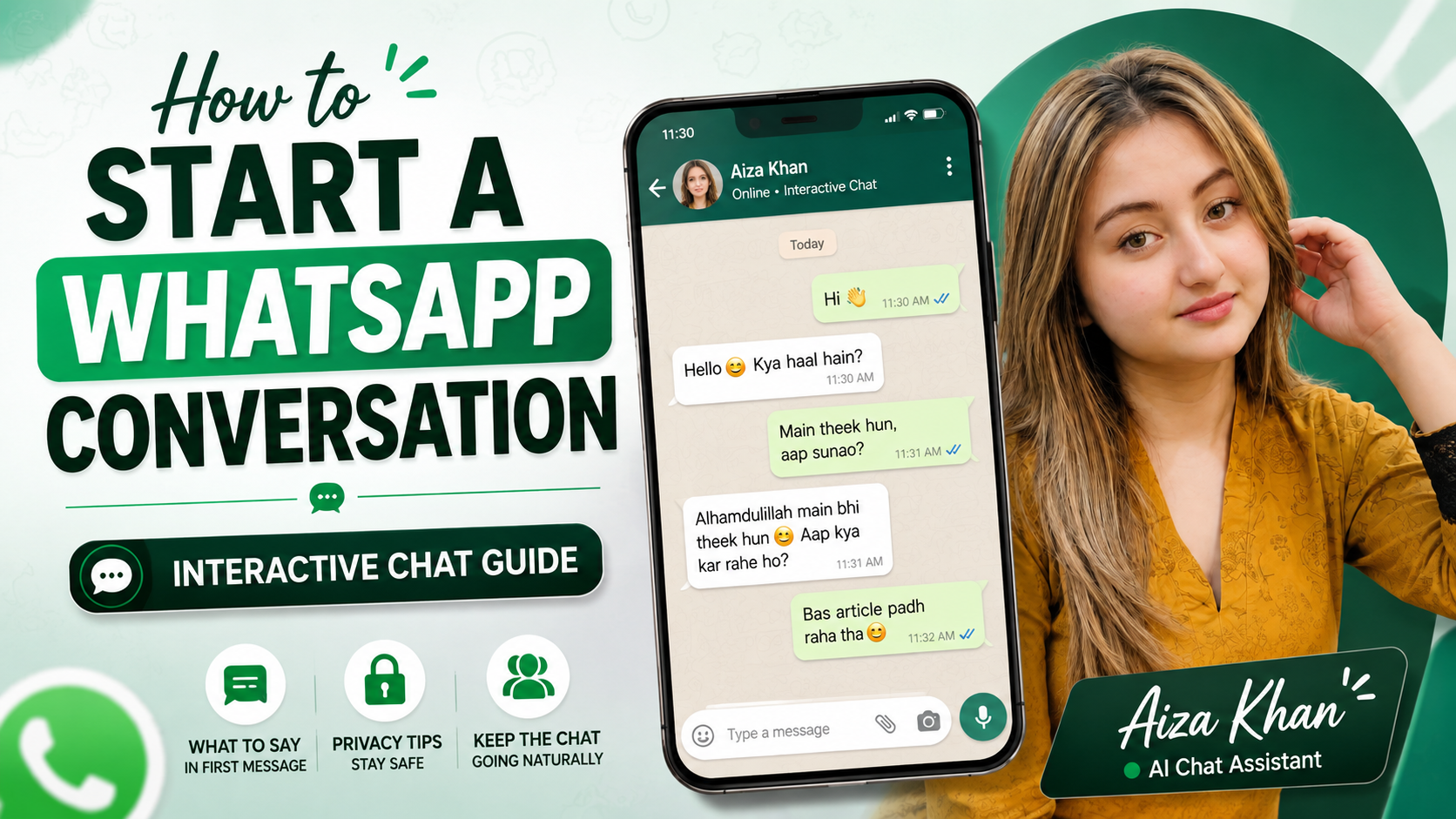
How to Start a WhatsApp Conversation: Interactive Chat Guide
Starting a WhatsApp conversation sounds simple until the chat box is open and nothing feels right to type. The first message decides whether you get a warm reply, a one-word answer, or silence. This guide shows you exactly how to start a chat on WhatsApp, what your first message should say, how to keep the conversation going without sounding forced, and which privacy habits protect you when you are chatting with someone new. You can also try the interactive chat demo below to practise sending a first message before you send a real one.
Practise Your First Message: Interactive Chat Demo
Type anything you like in the box below — a greeting, a question, or a random line — and see how a reply lands. Aiza Khan is a fictional AI character created for this page, and she answers in Roman Urdu.

This is a scripted demo that runs entirely in your browser. Aiza Khan is not a real person, not a support agent, and no message you type here is sent, stored, or shared. This page is not affiliated with, endorsed by, or connected to WhatsApp or Meta.
How to Start a Conversation on WhatsApp
A WhatsApp conversation starts the moment you give the other person something easy to reply to. That is the whole trick. Most chats die because the opener leaves nothing to answer — “hi” on its own puts all the work on the receiver, and busy people quietly skip it.
Before you type, check three things: does this person know who you are, do they expect a message from you, and do you have a reason for writing? If the answer to the first is no, your opener needs to include your name and how you got their number. If the answer to the last one is no, wait until you have one.
Practical ways to open a chat that actually go somewhere:
- Use a shared event. A wedding, a class, a group project, a Facebook page you both follow — mention it in the first line so the person can place you instantly.
- Ask something answerable. A question with a short, concrete answer gets replies far more often than an open-ended “so tell me about yourself”.
- Say what you need. If you are messaging about work, a price, a booking, or a document, put that in the first two sentences instead of warming up for five messages.
- Reply to their status. If they posted a status update, reacting to it is a natural, low-pressure way to open a thread.
One message, not five
Send your greeting, your name, and your reason in a single message. Splitting them into “hi”, “hello”, “are you there” and “?” reads as pressure, and it is the fastest way to get muted.
What Should Your First WhatsApp Message Say?
Your first WhatsApp message has three jobs: identify you, explain why you are writing, and give the other person an easy opening to respond. Keep it under about forty words. Here are four openers you can adapt.
Notice what these have in common. Each one names the sender or the context, each one ends with something answerable, and none of them demands an immediate reply. Avoid opening with a compliment about someone’s appearance, a long paragraph, or a forwarded message — all three make a new contact uncomfortable.
Keep the Conversation Natural
Once you get a reply, the goal shifts from starting the chat to keeping it comfortable. Natural conversation is mostly listening, and on WhatsApp listening means answering the thing the other person actually wrote.
Respond to their words, not your script. If they mention they just got back from a trip, ask about the trip. Skipping past what someone said to deliver your next prepared question makes the chat feel like a form.
Ask relevant questions, one at a time. Three questions in one message usually gets one answer and two ignored lines. Pick the one you actually care about.
Match their energy. If they send short replies, send short replies. If they use voice notes, voice notes are probably welcome. Long messages sent to someone writing two words at a time create an imbalance they will feel.
Don’t stack messages. Sending four messages in a row before they answer once is the most common reason new chats get muted or blocked. Say your piece and wait.
Respect slow replies and silence. People read messages at a red light and forget to answer. A single follow-up after a day or two is fine. After that, let it go — someone who wants to talk will come back.
WhatsApp Privacy Tips Before Chatting With Someone New
Before you open a conversation with a person you have never met, spend two minutes in your own settings. WhatsApp lets you decide who can see your personal details, and the defaults are more open than most people expect.
- Check who can see your profile photo, About, and last seen. In WhatsApp’s privacy settings you can limit these to your contacts, or to contacts except a chosen few. A stranger does not need your photo.
- Control status visibility. Status updates often show more about your daily routine than any chat does — your workplace, your children, your street. Restrict them.
- Turn on two-step verification. This adds a PIN that is required before your number can be registered on a new device. It is the single strongest protection against account takeover.
- Keep read receipts in mind. If they are on, the other person sees when you read a message. Turning them off also hides theirs from you.
- Know where block and report are. Both live inside the chat and the contact screen. Using them early is normal, not rude.
Verify before you trust
A profile photo and a name prove nothing. If someone claims to be a person you know, confirm through a channel you already trust before you share anything — especially if the conversation turns to money.
Things You Should Avoid
Some habits end conversations, and a few of them end with your account or your money at risk. Keep this list in mind from the first message onward.
- Bulk and repeated messages. Sending the same text to many people, or the same text repeatedly to one person, invites blocks and reports, and repeated reports can get a number restricted.
- Suspicious links. Prize claims, job offers with no company name, delivery notices you weren’t expecting, and shortened links from strangers all deserve the same response: don’t tap.
- Sharing an OTP or password. No genuine service, employer, or friend needs your verification code. Anyone asking for it is trying to take over an account.
- Sensitive personal information. Your home address, ID card, bank details, workplace schedule, or photos of family members should not go to a contact you have known for two days.
- Ignoring boundaries. A short answer, a long delay, or “I’m busy” is a signal. Pushing past it rarely changes the outcome and usually ends the chat permanently.
- Money requests from new contacts. Urgency plus a payment request is the shape of almost every messaging scam. Slow down and verify by voice.
Frequently Asked Questions
Can I start a WhatsApp conversation with someone new?
Yes, as long as you have their number and a genuine reason to write. Introduce yourself in the first message, explain how you got the number, and keep it to one message. If they don’t reply, treat that as an answer.
What should I say in my first message?
Your name, the context that connects you, and one easy question. For example: “Hi, I’m Hina from the Tuesday yoga class — did you get the schedule for next week?” That gives the other person everything they need to reply in seconds.
Should I share personal information with someone I just met?
No. Hold back your address, ID documents, financial details, workplace routine, and family photos until you know the person offline or through people you already trust. There is no rush, and a reasonable person will not push.
What should I do if someone sends me a suspicious link?
Don’t open it. Don’t forward it either, even to ask a friend whether it’s safe. Delete the message, and if the sender is unknown, block and report the contact from inside the chat.
How can I keep a new WhatsApp conversation comfortable?
Keep messages short, ask one question at a time, answer what they actually said, and leave space between messages. Comfort comes from pace as much as content — a chat that doesn’t demand instant replies feels easy to stay in.
What if the other person does not reply?
Wait at least a day, then send one light follow-up. If that goes unanswered too, stop. Silence on WhatsApp usually means the person is busy or not interested, and repeated messages only make the second reason more likely.
Is the chat demo on this page a real conversation?
No. Aiza Khan is a fictional AI character, and the demo runs on a small script inside your browser. Nothing you type is sent anywhere, saved, or seen by a person, and refreshing the page clears it.
Starting a WhatsApp conversation well is a small skill with a big payoff: fewer ignored messages, easier introductions, and chats that stay pleasant for both sides. Write one clear message, give the other person something to answer, protect your own details while you get to know them, and let the conversation move at whatever pace suits you both.